
|
| You might also like: | Butterfly Glossary: W | Butterfly Glossary: V | Butterfly Glossary: D | Butterfly Glossary: Q | Butterfly Glossary: I | Today's featured page: 'Draw Colorful Circles' Book |
 Table of Contents |
Enchanted Learning ALL ABOUT BUTTERFLIES! |
Butterfly Calendar |
| What is a Butterfly? | Life Cycle | Butterfly Anatomy | Information Sheets | Glossary | Printables and Activities |
| Butterfly Glossary |
| A | B | C | D | E | F | G | H | I | J | K | L | M | N | O | P | Q | R | S | T | U | V | W | X-Z |
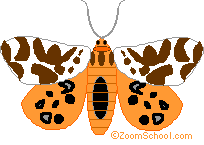 GARDEN TIGER MOTH The Garden Tiger (Arctia caja), also known as the Great Tiger Moth, is a common moth that is has a 1.8-2.8 inch (4.5-7 cm) wingspan. Its caterpillar, the black woolly bear, has long black hairs on top and rust-colored hairs on the underside. It is found in Europe and Asia in temperate regions, and less frequently in the Canada and Northern USA. Family Arctiidae. |
GENUS In classification, a genus is a group of related or similar organisms. A genus contains one or more species. A group of similar genera (the plural of genus) forms a family. In the scientific name of an organism, the first name is its genus (for example, people are Homo sapiens - our genus is Homo). |
GEOLOGICAL TIME The history of the earth is described in geological time, which is measured in millions of years and billions of years. The divisions used are: eon, era, period, and epoch. |
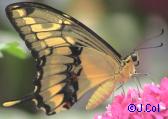 GIANT SWALLOWTAIL BUTTERFLY The giant swallowtail butterfly, also called the orangedog butterfly (Papilio cresphontes) is a large black and yellow butterfly with a yellow body. Eggs are tiny, yellow and circular. The caterpillar, which looks a bit like a small, black, white, and brown snake, is considered a pest (because it eats many agricultural species, including orange tree leaves). The chrysalis is brown. This butterfly lives in much of North America. Classification: Family Papilionidae (swallowtail butterflies), Genus Papilio, Species P. cresphontes. |
GIRDLE The girdle is a silken thread that a caterpillar wraps around its body as a support, attaching the larva to a twig or leaf as it is about to enter the pupa stage. |
GOLDEN BIRDWING The golden birdwing, Ornithoptera aeacus, is a large butterfly is from southeast Asia (including Thailand, the Himalayas, Tibet, Burma, Sikkim, and southern China). It has a wingspan of 120 mm to 190 mm. A swallowtail and a birdwing, it is gold with a black body, veins and markings. The caterpillar eats Aritolochia griffithi. Ornithoptera aeacus was named by C. & R. Felder, in 1860. |
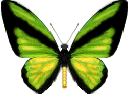 GOLIATH BIRDWING BUTTERFLY The Goliath Birdwing (Ornithoptera goliath) is the second-largest butterfly in the world. This brightly-colored butterfly is poisonous and has a wingspan up to 11 inches (28 cm) wide. It has black, yellow and green wings and a yellow and black body. This butterfly in found in tropical forests in Indonesia. Family Papilionidae |
GOSSAMER-WINGED BUTTERFLIES The gossamar-winged butterflies (family Lycaenidae) include the hairstreaks, coppers, blues, and harvesters. They are small butterflies - some have a tail-like projection on the bottom of the hind wings (hence their name - hairstreak). Males have reduced forelegs. The undersides of the wings are speckled. The caterpillars are slug-like. |
  GYMNOSPERM Gymnosperms are seed-bearing plants that that don't produce flowers. They release pollen into the air to the female ovule, causing fertilization. Their seeds develop without a protective covering. The earliest gymnosperms were seed ferns from the Devonian period (408-360 million years ago). Conifers (like pines, redwoods, and gingkos), and cycads are gymnosperms. |
|
Butterfly Glossary |
|
|||||
| A | B | C | D | E | F | G | H | I | J | K | L | M | N | O | P | Q | R | S | T | U | V | W | X-Z |
Enchanted Learning®
Over 35,000 Web Pages
Sample Pages for Prospective Subscribers, or click below
|
Overview of Site What's New Enchanted Learning Home Monthly Activity Calendar Books to Print Site Index K-3 Crafts K-3 Themes Little Explorers Picture dictionary PreK/K Activities Rebus Rhymes Stories Writing Cloze Activities Essay Topics Newspaper Writing Activities Parts of Speech Fiction The Test of Time
|
Biology Animal Printouts Biology Label Printouts Biomes Birds Butterflies Dinosaurs Food Chain Human Anatomy Mammals Plants Rainforests Sharks Whales Physical Sciences: K-12 Astronomy The Earth Geology Hurricanes Landforms Oceans Tsunami Volcano |
Languages Dutch French German Italian Japanese (Romaji) Portuguese Spanish Swedish Geography/History Explorers Flags Geography Inventors US History Other Topics Art and Artists Calendars College Finder Crafts Graphic Organizers Label Me! Printouts Math Music Word Wheels |
Click to read our Privacy Policy
| Search the Enchanted Learning website for: |