
|
| You might also like: | The Sun's Size - Zoom Astronomy | Sunspots | The Sun | Solar Flares, Prominences, and the Solar Wind | Sun Puzzle - Zoom Astronomy | Today's featured page: Art Activities and Projects for Students |
| Our subscribers' grade-level estimate for this page: 3rd - 4th |
| Table of Contents | Enchanted Learning All About Astronomy |
Site Index |
| Our Solar System | Stars | Glossary | Printables, Worksheets, and Activities | ||||||
| The Sun | The Planets | The Moon | Asteroids | Kuiper Belt | Comets | Meteors | Astronomers | ||
| THE SUN |
| Introduction to the Sun | Solar Structure | Size, Mass | Flares, |
Sun's Birth | Solar Eclipses | Activities, Web Links |
|---|---|---|---|---|---|---|
| Solar Rotation | Sunspots | Sun's Death |
 Our sun is a star located at the center of our Solar System. It is a huge, spinning ball of hot gas and nuclear reactions that lights up the Earth and provides us with heat.
The sun's absolute magnitude (its intrinsic brightness) is +4.83. Its stellar type is G (a star that absorbs strong metallic lines in its spectrum).
The Greeks called the Sun "Helios"; the Romans called it "Sol."
HOW FAR AWAY IS THE SUN?
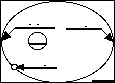 Planet-Sun Orbital Diagram Label the aphelion (farthest point in orbit) and perihelion (closest point in orbit) of a planet in orbit. Answers |
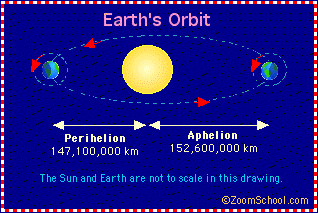 The Earth is closest to the Sun (this is called perihelion) around January 2 each year (91.4 million miles = 147.1 million km); it is farthest away from the Sun (this is called aphelion) around July 2 each year (94.8 million miles = 152.6 million km).
THE TEMPERATURE OF THE SUN
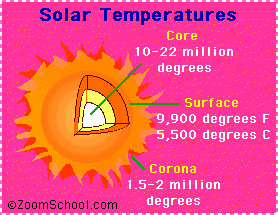 The Sun's core can reach 10 to 22.5 million°F. The surface temperature is approximately 9,900°F (5,500°C). The outer atmosphere of the Sun (which we can see during a solar eclipse) gets extremely hot again, up to 1.5 to 2 million degrees. At the center of big sunspots the temperature can be as low as 7300 °F (4300 K, 4000 °C). The temperature of the Sun is determined by measuring how much energy (both heat and light) it emits.
COMPOSITION OF THE SUN
The Sun is made up of about 2 x 1030 kilograms of gas. It is composed of about 75% hydrogen and 25% helium. About 0.1% is metals (made from hydrogen via nuclear fusion). This ratio is changing over time (very slowly), as the nuclear reactions continue, converting smaller atoms into more massive ones.
Since the Sun formed 4.5 billion years ago, it has used up about half of its initial hydrogen supply.
Our Sun is a seond or third generation star. Second generation stars do not just burn hydrogen, they also burn heavier elements, like helium and metals (elements heavier than hydrogen and helium), and were formed from supernova explosions (the debris of exploded population II stars).
The element helium was named after the Sun (called "Helios" in Greek) because it was first discovered on the Sun. Helium is plentiful on the Sun but rare on Earth. The element helium was discovered by Jules Janssen during the total solar eclipse of 1868 when he detected a new line in the solar absorption spectrum; Norman Lockyer suggested the name helium.
The composition of the Sun is studied using spectroscopy in which the visible light (the spectrum) of the Sun is studied.
NUCLEAR ENERGY PRODUCTION
At the Sun's core, nuclear fusion produces enormous amounts of energy, through the process of converting hydrogen nuclei into helium nuclei (nuclear fusion).
Although the nuclear output of the sun is not entirely consistent, each second the Sun converts about 600,000,000 tons of hydrogen nuclei into helium nuclei. These fusion reactions convert part of these atoms' mass (roughly 4 million tons) into energy, and release an enormous amount of this heat and light energy into the Solar System. In these fusion reactions, the Sun loses 4 million tons of mass each second. The Sun will run out of fuel in about 5 billion (5,000,000,000) years. When this happens, the Sun will explode into a planetary nebula, a giant shell of gas that will destroy the planets in the Solar System (including Earth).
AGE OF THE SUN
The Sun formed 4.5 billion years ago, as the solar system coalesced from a cloud of gas and dust.
STUDYING THE SUN
Astronomers study the Sun using special instruments. Scientists analyze how and why the amount of light from the Sun varies over time, the effect of the Sun's light on the Earth's climate, spectral lines, the Sun's magnetic field, the solar wind, and many other solar phenomena. The outer regions of the Sun (the corona) are studied during solar eclipses.
NEVER LOOK DIRECTLY AT THE SUN! Looking at the Sun can blind you or cause cataracts.
SOLAR EXPLORATION
The Ulysses spacecraft, a joint mission of the European Space Agency (ESA) and the National Aeronautics and Space Administration (NASA), was launched from the space shuttle on October, 1990 to explore the sun. It has studied the sun's magnetism, solar prominences and coronal mass ejections (orbiting over the south pole of the Sun in 1994 and over the north pole in 1995), and will will complete a second solar orbit in December, 2001.
Sun Activities
A quiz about the Sun
An interactive puzzle about the Sun
Label the Planet-Sun Orbital Diagram. Answers.
Enchanted Learning®
Over 35,000 Web Pages
Sample Pages for Prospective Subscribers, or click below
|
Overview of Site What's New Enchanted Learning Home Monthly Activity Calendar Books to Print Site Index K-3 Crafts K-3 Themes Little Explorers Picture dictionary PreK/K Activities Rebus Rhymes Stories Writing Cloze Activities Essay Topics Newspaper Writing Activities Parts of Speech Fiction The Test of Time
|
Biology Animal Printouts Biology Label Printouts Biomes Birds Butterflies Dinosaurs Food Chain Human Anatomy Mammals Plants Rainforests Sharks Whales Physical Sciences: K-12 Astronomy The Earth Geology Hurricanes Landforms Oceans Tsunami Volcano |
Languages Dutch French German Italian Japanese (Romaji) Portuguese Spanish Swedish Geography/History Explorers Flags Geography Inventors US History Other Topics Art and Artists Calendars College Finder Crafts Graphic Organizers Label Me! Printouts Math Music Word Wheels |
Click to read our Privacy Policy
| Search the Enchanted Learning website for: |