
|
| Table of Contents | Enchanted Learning All About Astronomy |
Site Index |
| Our Solar System | Stars | Glossary | Printables, Worksheets, and Activities | ||||||
| The Sun | The Planets | The Moon | Asteroids | Kuiper Belt | Comets | Meteors | Astronomers | ||
 |
 |
||||||
| A | B | C | D | E | F | G | H | I | J | K | L | M | N | O | P | Q | R | S | T | U | V | W | X | Y | Z |
ULTRAVIOLET RAYS Ultraviolet rays are a type of electromagnetic radiation with very short wavelengths (below those of the color blue). Ultraviolet rays are invisible to us. The ozone layer traps much of the Sun's ultraviolet energy coming through Earth's atmosphere. |
ULTRAVIOLET TELESCOPE An ultraviolet telescope recieves UV rays (a type of electromagnetic radiation with very short wavelengths) from space. Since the ozone layer traps much of the Sun's ultraviolet energy coming through Earth's atmosphere, orbiting UV telescopes like the Hopkins Ultraviolet Telescope (HUT) are now used. |
ULYSSES The Ulysses spacecraft, a joint mission of the European Space Agency (ESA) and the National Aeronautics and Space Administration (NASA), was launched from the space shuttle on October, 1990 to explore the Sun. It will study the sun's magnetism, solar wind plasma, solar prominences, gamma ray emissions, coronal mass ejections, and other solar phenomena. |
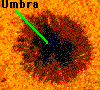 UMBRA The umbra is the inner, dark, cool (3700 K = 6600 °F = 3400 °C) region of a sunspot. The umbra of a sunspot can be up to 12,000 miles (20,000 km) wide. In the umbra, the Sun's magnetic field is very strong. (Compare to penumbra) |
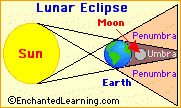 UMBRA The umbra is the area of total shadow (compare to penumbra). |
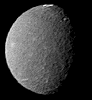 UMBRIEL Umbriel is one of the larger of the 18 moons of Uranus, and the darkest. It has a heavily-cratered surface, indicating an old surface. It has a bright ring at its top (probably a crater floor) called a fluorescent cheerio. Umbriel was discovered by Wm. Lassell in 1851. Umbriel has a diameter of 1,170 km and orbits, on average, 265,970 km from Uranus. It has a mass of 1.27x10+21 |
UNDAE Undae are dunes. There are undae on Mars. |
UNIVERSE The universe is everything, all matter and energy that is in existence. |
UNIVERSAL GRAVITATIONAL CONSTANT The universal gravitational constant (abbreviated G) is the constant of proportionality in Newton's equation (formulated in 1666) that describes the gravitational attraction between objects; their gravitational attraction (F) depends only on their masses and the distance between them, according to the formula |
UNIVERSAL TIME Universal time (abbreviated UT) is the same as Greenwich Mean Time (abbreviated GMT); it is the time zone of Greenwich, England (longitude zero). |
UPSILON ANDROMEDAE Upsilon Andromedae is a star in the constellation Andromeda. Astronomers Geoffrey W. Marcy and R. Paul Butler discovered a massive planet orbiting this star (with each orbit taking only 4.6 days.) in 1996. Recently, 2 even more massive planets have been discovered orbiting this star. The three planets orbit within 2.5 Astronomical Units of the star. |
URANIA Urania was the Greek muse of astronomy. |
URANOMETRIA Uranometria was a detailed star chart/catalog made by Johannes Bayer in 1603. It contained 51 star charts (one for each of the 48 Ptolemaic constellations, a chart of the newly-discovered southern skies, and two planispheres), using his new method of classifying stars. The current edition of Uranometria plots every star in the sky down to magnitude 9.5 (each star is given a Uranometria Chart Number). |
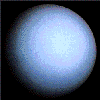 URANUS Uranus is the seventh planet from the sun. This huge, icy planet is covered with clouds and is encircled by a belt of 11 rings and 18 moons. This gas giant is the third-largest planet in our Solar System (after Jupiter and Saturn), and is about 4 times the diameter of Earth and 14 times as massive. |
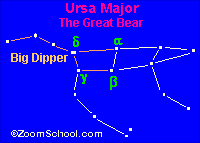 URSA MAJOR Ursa Major (The Great Bear) is a well-known constellation in the Northern Hemisphere that contains the 7 stars of the Big Dipper. The two brightest stars in Ursa Major (Dubhe and Merak) "point" to the current North Star, Polaris. |
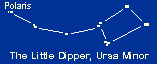 URSA MINOR Ursa minor (The Little Bear) is a Northern Hemisphere constellation that is also known as the Little Dipper. This group of stars starts at Polaris, the pole star of the Northern Hemisphere |
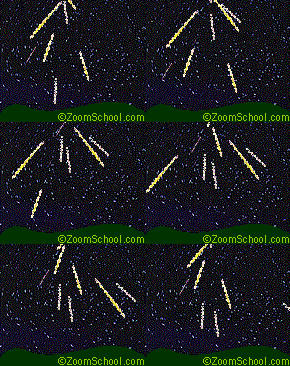 URSID METEOR SHOWER The Ursids are a meteor shower that occur each year from Dec. 17-25, with a maximum on Dec. 22. This meteor shower occurs each year as the Earth passes through the orbit of comet Tuttle 1790, and icy remnants of the comet burn up as they enter the Earth's atmosphere. The meteors in this shower seem to emanate from the constellation Ursa Minor, (but they do not). |
UV UV stands for ultraviolet radiation. |
|
|
||||||
| A | B | C | D | E | F | G | H | I | J | K | L | M | N | O | P | Q | R | S | T | U | V | W | X | Y | Z |
Enchanted Learning®
Over 35,000 Web Pages
Sample Pages for Prospective Subscribers, or click below
|
Overview of Site What's New Enchanted Learning Home Monthly Activity Calendar Books to Print Site Index K-3 Crafts K-3 Themes Little Explorers Picture dictionary PreK/K Activities Rebus Rhymes Stories Writing Cloze Activities Essay Topics Newspaper Writing Activities Parts of Speech Fiction The Test of Time
|
Biology Animal Printouts Biology Label Printouts Biomes Birds Butterflies Dinosaurs Food Chain Human Anatomy Mammals Plants Rainforests Sharks Whales Physical Sciences: K-12 Astronomy The Earth Geology Hurricanes Landforms Oceans Tsunami Volcano |
Languages Dutch French German Italian Japanese (Romaji) Portuguese Spanish Swedish Geography/History Explorers Flags Geography Inventors US History Other Topics Art and Artists Calendars College Finder Crafts Graphic Organizers Label Me! Printouts Math Music Word Wheels |
Click to read our Privacy Policy
| Search the Enchanted Learning website for: |