

Advertisement.

EnchantedLearning.com is a user-supported site.
As a bonus, site members have access to a banner-ad-free version of the site, with print-friendly pages.
Click here to learn more.

Become a member of Enchanted Learning.
Site subscriptions last 12 months.
Click here for more information on site membership.

As low as $20.00/year (directly by Credit Card)

Site members have access to the entire website with print-friendly pages and no ads.
(Already a member? Click here.)

An Enchanted Learning® Web Page
Zoom Explorers
A B C D E F G H I J K L M N O P Q R S T U V W X Y Z
Africa Antarctica Arctic Australia Canada Mexico North America South America Space Undersea Women
1300's and Earlier 1400's Early 1500's Late 1500's 1600's 1700's 1800's 1900's Glossary of Exploration Terms

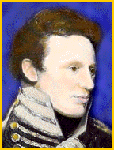
Zebulon Montgomery Pike: American Explorer

Zebulon Montgomery Pike (January 5, 1779 - April 27, 1813) was an American explorer and military officer (he served in the War of 1812). Pike tried to find the source of the Mississippi River and also explored the Rocky Mountains and southwestern North America. Pike's Peak in Colorado is named for him.

The Source of the Mississippi River:
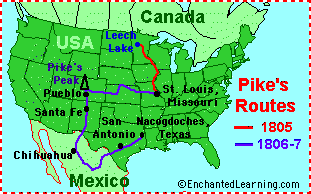
Pike was sent to Minnesota by General James Wilkinson (Governor of the Louisiana Territory) to search for the source of the Mississippi River in 1805. Pike led a crew of 20 men from St. Louis to upper Minnesota during the fall and winter. They traveled on boats, and then sleds (when the river iced over). Although the actual source is Lake Itasca, Pike was convinced that the nearby Lake Leech was the source.

The Rocky Mountains:
General Wilkinson then sent Pike to the Rocky Mountains and the southwest in 1806, but was officially told not to enter Spanish territory. Pike discovered Pike's Peak in Colorado, but failed to climb it. Continuing south, Pike did enter Spanish territory, and was arrested and taken to Santa Fe (in what is now New Mexico). Pike was one of the first Americans to see New Mexico. He was released by the Spanish in Louisiana. His notes about his journey mistakenly stated that the area he traveled in was mostly a desert, unsuitable for farming. This discouraged the settlement of the area for quite a while, but trade increased and Pike's information on the military weakness of the Spanish was quite important.

General Pike died in 1813 during the War of 1812 at the battle of York (in Canada); Pike commanded the American troops at the battle of York.

Enchanted Learning® Web Page
Zoom Explorers
Search EnchantedLearning.com for your explorer:
A B C D E F G H I J K L M N O P Q R S T U V W X Y Z
Africa Antarctica Arctic Australia Canada Mexico North America South America Space Undersea Women
1300's and Earlier 1400's Early 1500's Late 1500's 1600's 1700's 1800's 1900's Glossary of Exploration Terms
Guidelines for Writing a Report on an Explorer


Enchanted Learning®
Over 20,000 Web Pages.
Sample Pages for Prospective Subscribers

Overview of Site
What's New
Enchanted Learning Home
Monthly Activity Calendar
Books to Print
Site Index

K-3
Crafts
K-3 Themes
Little Explorers
Picture dictionary
PreK/K Activities
Rebus Rhymes
Stories
Writing
Cloze Activities
Essay Topics
Newspaper
Writing Activities
Parts of Speech

Fiction
The Test of Time
Biology
Animal Printouts
Biology Label Printouts
Biomes
Birds
Butterflies
Dinosaurs
Food Chain
Human Anatomy
Mammals
Plants
Rainforests
Sharks
Whales
Physical Sciences
Astronomy
The Earth
Geology
Hurricane
Landforms
Oceans
Tsunami
Volcano
Languages
Dutch
French
German
Italian
Japanese (Romaji)
Portuguese
Spanish
Swedish
Geography/History
Explorers
Flags
Geography
Inventors
US History

Other Topics
Art and Artists
Calendars
Crafts
Graphic Organizers
Label Me! Printouts
Math
Music

Click to read our Privacy Policy

E-mail


Enchanted Learning Search

First search engine with spelling correction and pictures!
Search EnchantedLearning.com for all the words:
Enter one or more words, or a short phrase.
You can use an asterisk * as a wild-card.


Advertisement.


Advertisement.


Copyright ©2000-2008 EnchantedLearning.com ------ How to cite a web page